Leave Your Message
For global buyers, a Small Fiberglass Boat is more than a compact leisure craft. It can be a practical answer to transport, storage, and maintenance challenges. Its modest size may reduce shipping complexity, marina costs, and launching requirements. Yet small does not mean simple. Hull shape, laminate quality, cockpit drainage, fuel-system design, and flotation deserve careful inspection.
Naval architect C. Raymond Hunt expressed a valuable design principle: “The deep-V is not a compromise; it is a solution.” His words remain useful when buyers compare fiberglass boats for coastal passages, fishing, or family recreation. A well-designed Small Fiberglass Boat can soften short, steep waves and remain predictable during turns. That matters when the water suddenly changes from glassy to choppy. It also matters when an inexperienced passenger moves across the deck.
Experienced buyers should examine the hull from several angles. Look for uneven gelcoat, repaired impact marks, loose fittings, and water inside storage compartments. Ask for construction details, engine service records, load guidance, and available replacement parts. A clean brochure is not proof of a strong boat. Hands-on inspection is better.
There is an uncomfortable truth. The cheapest model may become expensive after delivery. Freight, taxes, trailer changes, electronics, and regional safety requirements can quickly alter the budget. Buyers should also confirm local registration and operating rules before purchase. A Small Fiberglass Boat may fit many lifestyles, but not every shoreline, climate, or family. Choosing well requires honest self-questioning: where will it run, who will use it, and what mistakes must the boat forgive?
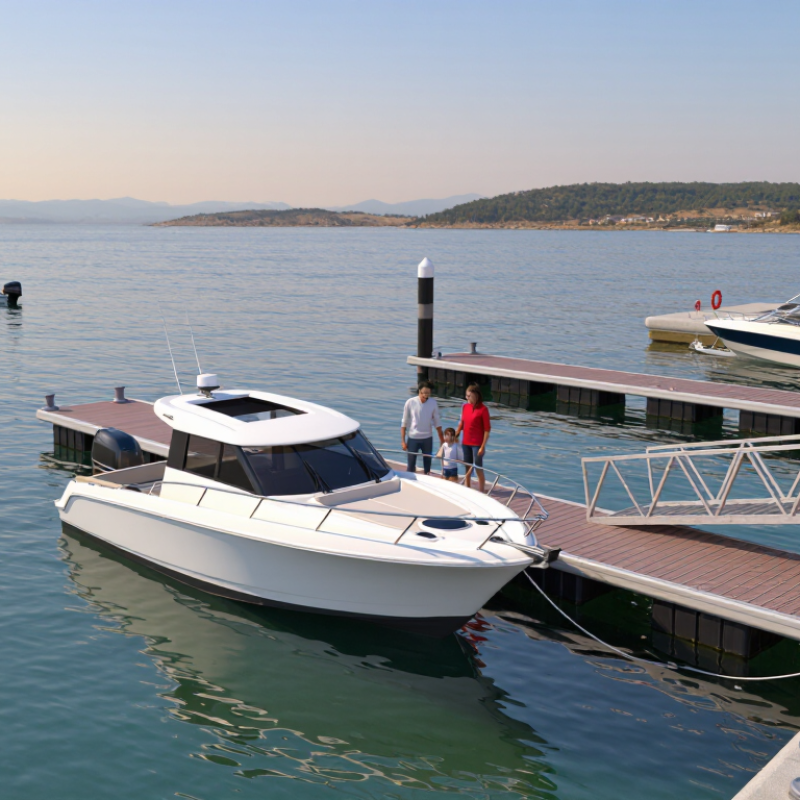
Why Choose a Small Fiberglass Boat for Global Buyers?
In ISO 12215, “small craft” generally means boats with a hull length below 24 meters. Small fiberglass boats are not defined by fiberglass alone. The standard evaluates hull structure, design loads, scantlings, and operating conditions. ISO 12215-5:2019 addresses pressure and structural dimensions for monohull and multihull craft. Design categories also matter, from sheltered waters to ocean conditions.
This distinction helps global buyers compare boats more accurately. A 7-meter fiberglass day boat and a 7-meter offshore cruiser may require different structural calculations. The material can resist corrosion well, yet laminate quality, bonding, and core installation remain critical. The International Organization for Standardization provides the framework, but builders must apply suitable engineering methods. Buyers should request calculation records, construction drawings, and the declared design category. Certification language alone is not enough.
The National Marine Manufacturers Association reported 56.7 million American boating participants and a $230.1 billion annual economic impact in its 2023 Economic Impact Study. That figure reflects the United States, not the whole world. Still, it shows strong demand for accessible recreational craft.
Tip: Measure hull length, not trailer length. Ask which ISO 12215 parts were applied. Inspect laminate transitions, cockpit drainage, and hardware backing plates. These details are easy to overlook. I have found that buyers often focus on appearance first, then discover structural questions later. That ordering needs reconsideration.
| Data Dimension | Factual Definition or Reference Value | Why It Matters to Global Buyers |
|---|---|---|
| ISO 12215 scope | ISO 12215-5 covers the design pressures and structural scantlings of small-craft hulls, decks, superstructures and attached components for craft with a hull length (LH) of up to 24 m. | Provides a recognized technical framework for comparing boats intended for international markets. |
| Practical meaning of “small fiberglass boat” | A recreational or light-commercial craft under the 24 m ISO 12215 hull-length limit, built with glass-reinforced plastic (GRP), commonly called fiberglass. | Defines the product by measurable length, construction material and intended use rather than by a marketing label. |
| Hull-length limit | LH ≤ 24 m, measured according to the definitions used by ISO 12215. Length-overall figures may differ from LH because appendages and other features can be treated differently. | Buyers should request the declared ISO hull length instead of relying only on the advertised overall length. |
| Typical fiberglass construction | Glass fibres embedded in a polymer resin matrix, such as polyester, vinyl ester or epoxy. Construction may be solid laminate, sandwich laminate or a combination of both. | The laminate schedule, core material, bonding method and quality control are more important than the general word “fiberglass.” |
| ISO 12215-5 design categories |
A — Ocean: designed for conditions including significant wave heights above 4 m and wind force above 8, excluding abnormal conditions such as hurricanes. B — Offshore: designed for conditions up to and including significant wave heights of 4 m and wind force 8. C — Inshore: designed for conditions up to and including significant wave heights of 2 m and wind force 6. D — Sheltered waters: designed for conditions up to and including significant wave heights of 0.3 m and wind force 4. |
Helps buyers match the boat’s structural design to local waters, weather exposure and intended operating area. |
| Structural design basis | ISO 12215-5 considers design pressures, local loads, global strength and relevant structural elements such as hulls, decks, bulkheads, floors, girders and stiffeners. | A documented design basis makes technical comparison and pre-purchase verification easier across different countries. |
| Load and stability information | A buyer should verify maximum recommended load, maximum number of persons, engine limits, buoyancy or flotation provisions, and stability information in the technical documentation. | These values can affect safe operation, transport, registration and compliance with the destination market. |
| Common advantages of fiberglass | GRP enables moulded shapes, repeatable production, corrosion resistance in normal marine service and relatively low routine maintenance compared with many metallic hulls. | Supports consistent production and practical ownership for recreational, fishing, patrol and workboat applications. |
| Key limitations to assess | Fiberglass is not immune to impact damage, osmosis, water ingress or laminate defects. Repairs require compatible materials, correct surface preparation and controlled workmanship. | A pre-delivery inspection and access to repair procedures are important when purchasing across borders. |
| Global compliance note | ISO 12215 is a design and construction standard; it does not by itself replace the legal requirements of a destination country or region. Additional rules may cover emissions, electrical systems, safety equipment, identification, noise and certification. | Buyers should confirm local regulatory requirements before importing, registering or operating the boat. |
| Recommended buyer documents | Request the builder’s declaration or compliance documentation, hull-length definition, design category, maximum load, person capacity, engine rating, laminate specification, structural drawings and owner’s manual. | Creates a traceable technical record for shipping, insurance, registration, maintenance and resale. |
Reference note: ISO 12215 design categories and limits should be checked against the current edition of the standard and the applicable regulations in the intended market.